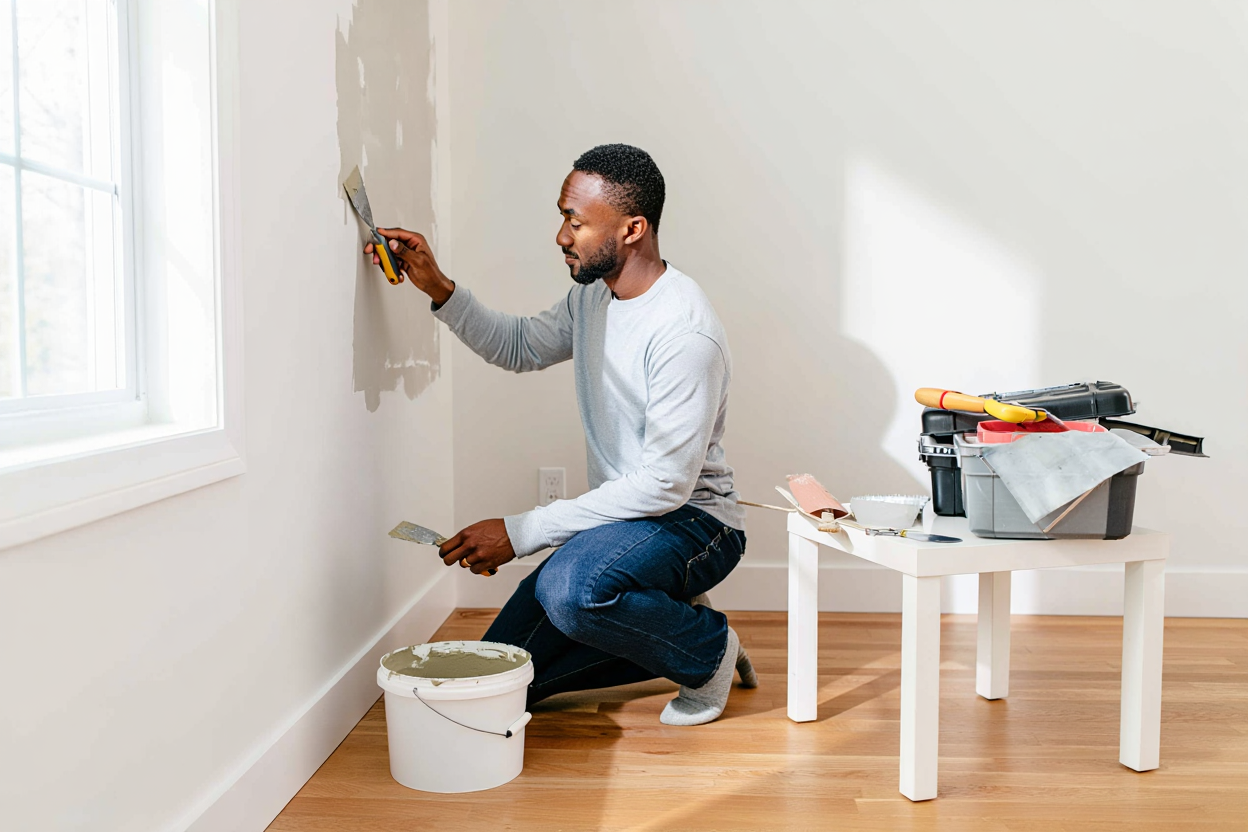
1. Fill nail holes with lightweight spackling compound
Clean out loose debris, apply spackling with putty knife slightly overfilled, let dry 24 hours, then sand smooth with 120-grit sandpaper. Prime and paint to match existing wall color.
2. Fix popped drywall screws with additional fasteners
Drive the popped screw slightly below surface, add new drywall screw 2 inches away, fill both holes with joint compound, sand smooth when dry. This prevents future pops.
3. Repair small cracks with mesh tape and compound
Clean out loose material, apply self-adhesive mesh tape over crack, cover with joint compound using 6-inch knife, feather edges smooth. Sand and paint when fully dry.
4. Patch tiny holes with self-adhesive mesh patches
Clean hole edges, apply mesh patch centered over hole, cover with thin coat of joint compound, let dry, sand smooth. These work perfectly for holes up to 2 inches diameter.
5. Touch up corner beads damaged by furniture impacts
Straighten bent metal corner bead with pliers, apply joint compound over the repair area, sand smooth when dry. Replace severely damaged corner bead sections entirely.
6. Patch doorknob holes with California patch method
Cut drywall square around hole, cut new piece slightly larger, remove backing material leaving just face paper, insert through hole, pull tight, and secure with joint compound.
7. Repair larger holes with drywall patch kits
Use metal mesh patch kits for holes 3-6 inches. Center patch over hole, apply joint compound in thin coats, feathering edges 6 inches beyond patch. Sand between coats for smooth finish.
8. Fix water damage stains with stain-blocking primer
Ensure area is completely dry, sand any raised edges, apply two coats of stain-blocking primer, then paint with quality paint. This prevents bleed-through of water stains.
9. Repair settlement cracks with flexible compound
Use flexible joint compound for cracks that may reopen due to house movement. Apply in thin coats, sand smooth, prime and paint. Monitor for recracking over several months.
10. Replace damaged drywall sections up to 16 inches
Cut out damaged area to nearest stud centers, install backing strips if needed, cut new drywall to fit, secure with screws, tape seams, apply three coats joint compound.
11. Apply joint compound in proper three-coat system
First coat covers tape and fasteners, second coat widens coverage 2 inches beyond first coat, third coat feathers edges smooth over 10-12 inch width for invisible repairs.
12. Sand between coats with proper grit progression
Use 120-grit for initial sanding, 150-grit for second coat prep, 220-grit for final smoothing. Always use dust mask and good lighting to check for imperfections.
13. Match existing wall texture with proper tools
Use knockdown knife for orange peel texture, sea sponge for light texture, brush for heavy texture. Practice on scrap drywall before applying to repair area.
14. Prime repairs with high-quality primer before painting
Use PVA primer on new drywall, stain-blocking primer over repairs. Primer prevents flashing and ensures paint color matches. Don't skip this critical step.
15. Blend repair areas seamlessly with proper paint technique
Paint beyond repair area in light, overlapping strokes. Use same paint sheen as existing wall. Two light coats give better coverage than one heavy coat.
Bonus Tip
Keep detailed notes and photos of your repair techniques that work well in your home. Different wall textures and paint types require specific approaches, so document what works for future repairs. Also save small amounts of paint from each room for touch-ups.
What to Avoid
- Never skip the primer step - it prevents paint flashing and ensures proper color matching on repairs
- Don't rush joint compound drying between coats - moisture trapped underneath causes cracking and poor adhesion
- Avoid using regular joint compound for cracks that may move - use flexible compound for settlement cracks
- Don't sand joint compound while it's still damp - this creates gouges and uneven surfaces that show through paint
- Never apply thick coats of joint compound thinking it saves time - thin multiple coats create smoother, stronger repairs